

EV Busbar Parts
EV Busbar Parts are critical components in electric vehicle power distribution systems, designed to carry high currents safely and efficiently between batteries, inverters, motors, charging units, and other electrical modules. As electric vehicles continue to evolve toward higher voltage platforms, compact architectures, and improved energy efficiency, the role of busbar parts becomes increasingly important. These parts help ensure stable electrical transmission, reduce power loss, and support the overall reliability of the vehicle’s electrical system.A busbar part is typically made from highly conductive metal materials such as copper or aluminum. Copper is widely used because of its excellent conductivity, thermal performance, and durability, while aluminum is often chosen for its lighter weight and cost advantages. In EV applications, the selection of material depends on the required current rating, weight targets, environmental conditions, and assembly design. To improve performance and prevent oxidation, busbar parts are often coated with tin, nickel, silver, or other protective surface finishes.EV busbar parts are designed in many shapes and configurations to fit different system layouts. They may be straight, bent, stamped, laminated, or custom-formed to match the internal space of battery packs, power distribution units, or motor control systems. Their design must support compact installation while maintaining electrical insulation, thermal management, and mechanical strength. Because EV systems often operate under vibration, heat, humidity, and continuous charging and discharging cycles, busbar parts must be engineered for long-term stability and resistance to fatigue.One of the main advantages of EV busbar parts is their ability to reduce resistance compared with traditional wiring harnesses. Lower resistance helps minimize energy loss and heat generation, improving overall system efficiency. Busbars also provide a cleaner and more organized layout, which is especially valuable in high-density battery packs and power electronics modules. Their rigid structure can simplify assembly, enhance safety, and improve consistency in manufacturing.In battery systems, EV busbar parts are commonly used to connect individual cells into modules and connect modules into larger battery packs. These connections must handle high current levels while maintaining balanced power flow. In power electronics, busbars support the transfer of electricity between components such as converters, inverters, and DC-DC systems. In charging systems, they help manage fast energy transfer safely and reliably.Custom design is often required for EV busbar parts because each vehicle platform has unique electrical and structural requirements. Engineers consider current capacity, voltage level, insulation distance, heat dissipation, packaging space, and assembly method when developing a busbar solution. Precision manufacturing processes such as stamping, bending, welding, riveting, and laser processing are commonly used to ensure accurate dimensions and consistent performance.Overall, EV busbar parts play a vital role in modern electric mobility. They contribute to efficient power delivery, improved safety, reduced weight, and reliable system operation. As EV technology advances, busbar parts will continue to support higher performance, greater integration, and more compact electrical designs.
Products
Category:
-
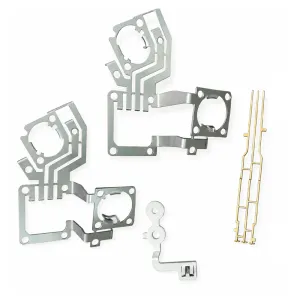
Precision Sheet Metal Busbar Parts for EV Modules
Category: EV Metal PartsBrowse number: 19Number:Release time: 2026-08-28 16:56:00These custom automotive busbar and stamped metal contact parts are designed for vehicle electrical systems, EV battery modules, power distribution units, sensor assemblies, and electronic control modules. The product group includes conductive metal frames, contact plates, formed connection pieces, and precision sheet metal electrical components. With complex cutouts, mounting holes, conductive paths, and formed structures, these parts help support current transfer, signal connection, grounding, positioning, and compact module assembly in modern automotive and electric vehicle applications.
News
Category:
No search results found!
Case
Category:
No search results found!
Video
Category:
No search results found!
Download
Category:
No search results found!
Job
Category:
No search results found!
Featured Products
No search results found!



 Phone
Phone